


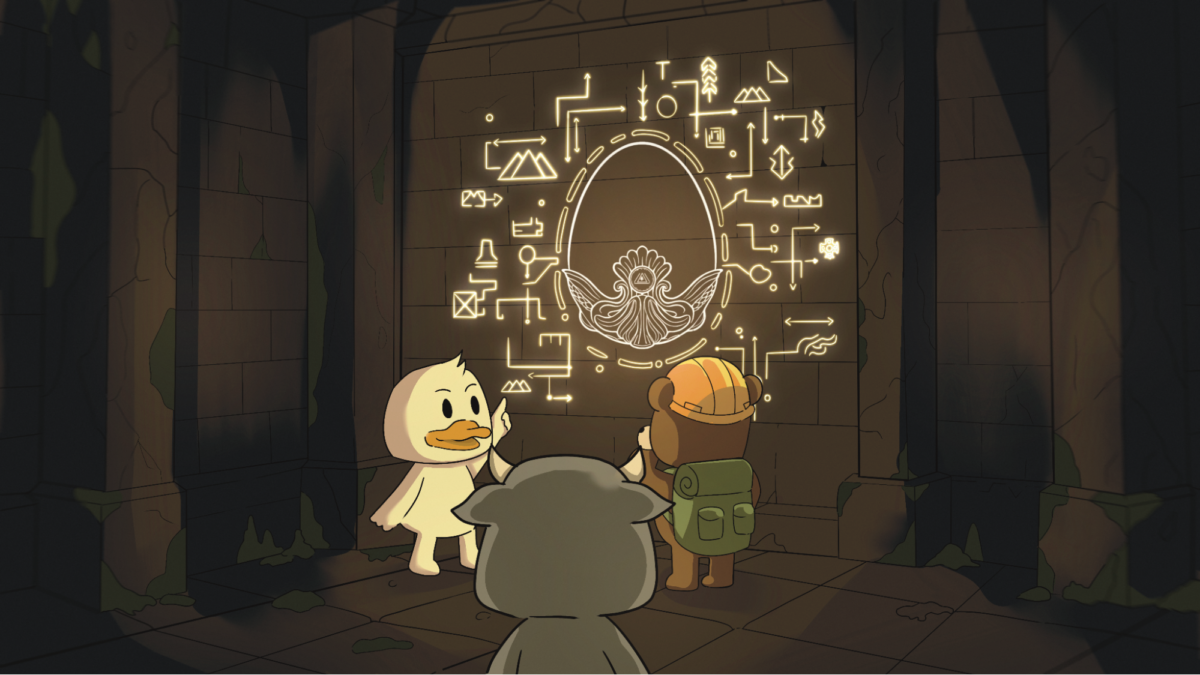
You mint a pack. And then the real decision starts.
That’s the moment Temple of Pax is built around.
Not the mint itself, not a reveal screen, not a rarity ranking that appears thirty seconds after you connect your wallet. The interesting part happens after, when you’re holding a sealed Genesis Pack and you actually have to think about what to do next.
Open it now. Hold it and watch the tracker. Or send it to the Mine and let it work while you wait.
That’s three genuinely different paths, and none of them is obviously right.
It’s a deal-or-no-deal dynamic with real information behind it, and that information is what makes the whole thing feel like a game worth playing rather than a drop worth guessing at.
What’s Inside the Pack
Each Genesis Pack contains three NFTs: a character and two functional equipment pieces that plug directly into the idle game layer.
Every pack also has a chance to contain a Rare Egg, tied to a premium unlock path inside the ecosystem.
And then there are Chonkas: the chase content that serious collectors are going to be watching for.
The Pax Tracker shows you exactly how many Eggs, Chonkas, and rare traits are still sitting inside unopened packs across the entire supply, updated in real time. So before you decide anything, you can actually read the room.
How much premium content is still out there? How fast is it moving? What does the remaining supply look like?
That’s not information most NFT projects give you. Temple of Pax builds the whole experience around it.
The Open-or-Hold Decision
This is where it gets interesting.
Say you mint a pack and pull up the Pax Tracker.
There are still a significant number of Eggs and Chonkas sitting in unopened supply. Maybe you hold: let others open first, watch the premium content thin out, make your move when the signal is clearer.
Or maybe the supply is already running low and you want in before it’s gone.
Neither choice is made blind.
The tracker is live. The data is on-chain.
Opening outcomes are powered by a verifiable random function, so the distribution logic is auditable because you’re not trusting a black box, you’re reading a system.
And then there’s the third option: don’t open at all.
Send the sealed pack to the Mine and let it accumulate in-game resources while you figure out your next move.
The pack stays sealed. The resources build. You haven’t committed to anything yet.
Deal or no deal. Except you actually have information.
The Idle Game Layer
The Mine isn’t a side feature.
It’s where a significant portion of the total rewards pool lives — and it’s only accessible through participation.
Characters mine resources over time.
Those resources get exchanged in the Artifact Shop for digital collectibles, physical goods, and rare items.
The Artifact Shop shows you exactly what’s claimable and how much of each reward remains: same transparency principle as the Pax Tracker, applied to the rewards side of the ecosystem.
To keep things balanced, there’s a cap on how many characters can mine per wallet simultaneously, and in-game resources are non-transferable. The design keeps the playing field from collapsing into early-mover dominance.
Everyone who participates has a real path to what’s available.
The rewards pool spans from blue-chip digital collectibles to physical goods and the full allocation is visible and trackable. You can see what’s in there before you decide how to play.
This Is Just the Beginning
Temple of Pax is currently in pre-launch, with mint details to be announced. Community is building on X and Discord, and the team — doxxed founders with backgrounds in private equity, venture capital, and AI-focused investing — is taking a deliberate approach to rollout.
And the Genesis Mint is explicitly designed as a starting point.
The Chonka Arcade concept is already in development as the next layer of the ecosystem.
The idle game, the sealed packs, the Artifact Shop — these are the foundation, not the ceiling.
For collectors who are tired of minting into nothing and waiting to see what happens, Temple of Pax is built around a different premise: give people real information, real decisions, and a system worth engaging with long after day one.

