



The idea behind play-to-earn gaming is easy to understand. Play a game, receive tokens or digital items, and exchange those rewards for money.
The difficult part is calculating what that time is actually worth.
A player might earn $10 in tokens during a week and feel as though the game paid them. But if earning and withdrawing those tokens took 15 hours, the effective rate was only 67 cents per hour. Any entry costs, marketplace charges and transaction fees reduce it further.
CryptoVantage examined how realistic play-to-earn income compares with minimum wages in the United States, United Kingdom, Germany, India and China. The result is fairly clear. Ordinary players are unlikely to earn minimum wage consistently in any of these countries. Highly skilled competitors may beat the wage floor in some markets during a strong month, but that is very different from receiving predictable hourly pay.
Playing a Game Is Not the Same as Having a Job
Play-to-earn games don’t employ their players. They generally don’t guarantee a fixed reward for each hour, cover equipment costs or compensate people when token prices fall.
Income can depend on several moving parts:
- The number of tokens awarded
- The token’s current market price
- The player’s skill and ranking
- The time required to complete eligible activities
- The availability of tournaments
- The cost of characters, cards or equipment
- Blockchain and marketplace fees
- Whether another party receives a share of the rewards
That makes play-to-earn income closer to a combination of competitive gaming, digital-item trading and speculative rewards than a conventional hourly wage.
Someone can play for three hours and receive nothing useful. Another player might sell a rare item and make more in a few minutes than they earned during the previous month. Looking only at the successful sale creates a misleading hourly rate.
How We Calculated the Hourly Rate
This analysis uses a simple formula:
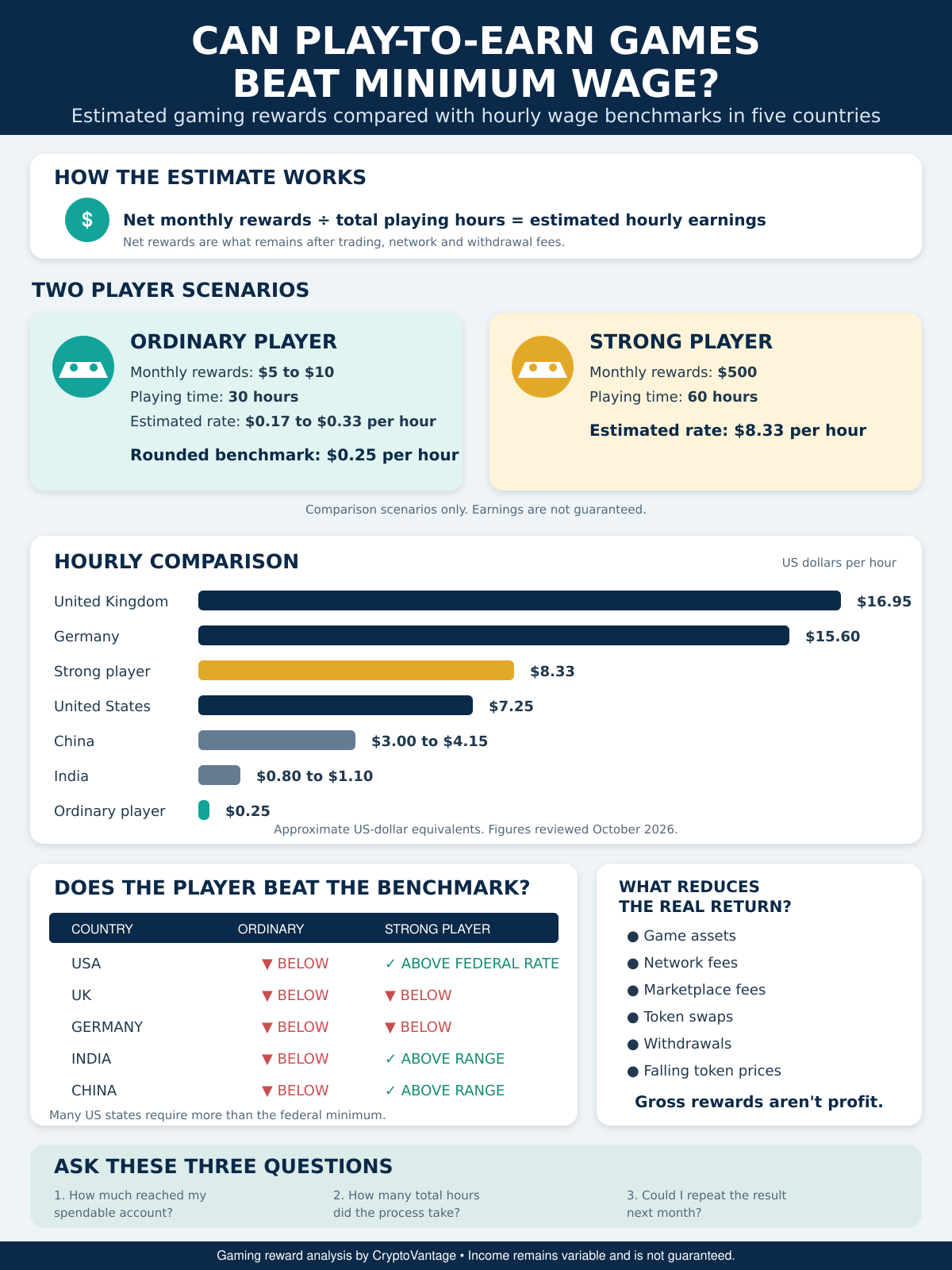
Net reward value ÷ total time spent = estimated hourly earnings
Net reward value means the amount left after necessary network, trading and withdrawal costs. Total time includes gameplay, claiming rewards, managing a wallet and converting tokens into spendable money.
Entry costs should be treated separately. If a player spends $120 on cards or characters before earning anything, those rewards aren’t profit until the original $120 has been recovered.
Readers unfamiliar with these systems can review how play-to-earn crypto games reward players. Games may distribute fungible tokens, tradeable cards, NFT characters or other blockchain assets, and each reward has a different route to cash.
The Ordinary Player Benchmark
Reliable game-by-game hourly figures are difficult to establish because rewards change and publishers rarely present them as wages. Player ability also creates enormous differences.
A reasonable low-end benchmark can be built from reports estimating that many ordinary play-to-earn users receive roughly $5 to $10 per month. If someone plays for one hour a day, or around 30 hours per month, that produces an effective rate of approximately:
- $5 monthly reward: $0.17 per hour
- $10 monthly reward: $0.33 per hour
We can use $0.25 per hour as a rounded ordinary-player benchmark.
This is an estimate, not a guaranteed rate for every game. Some players earn nothing. Others earn more because they rank highly, trade valuable items or win tournaments.
Even so, the benchmark shows why the phrase “earn while playing” needs context. A token reward can be real while still being too small to treat as income.
Axie Infinity Shows How Quickly the Economics Can Change
Axie Infinity became the best-known play-to-earn example during the 2021 crypto market. Players earned Smooth Love Potion, or SLP, by completing game activities and competing against other players.
The economics look very different when the reward token falls in value. In 2026, SLP has traded at only a small fraction of a cent, leaving routine farming rewards worth pennies rather than the income some players experienced during the game’s strongest period.
Axie also demonstrates why historical earnings shouldn’t be used as a current forecast. An old article may describe players supporting themselves with SLP, but that result depended on the token price, reward system, player demand and broader crypto market at that time.
The gameplay can continue after the income opportunity changes. That’s an important distinction.
Gods Unchained Rewards Skill and Tradeable Cards
Gods Unchained takes a different approach. The trading-card game is free to begin, and players can earn GODS tokens and cards through eligible competitive activities. Certain cards can be fused into blockchain assets that may be traded.
A new player shouldn’t assume every card has a ready buyer. Its value depends on scarcity, demand and usefulness within the game. Selling it also takes time.
Higher-ranked players can receive more valuable rewards, but reaching that level may require a strong collection and considerable experience. The hours spent learning the game still belong in the calculation.
This makes Gods Unchained closer to a competitive card game with digital prizes than a fixed-rate job. A skilled player might have a profitable week. Someone learning the basics may receive very little.
Alien Worlds Turns Repeated Claims Into Small Token Rewards
Alien Worlds allows players to mine for its TLM token using NFT tools and virtual land. Different equipment combinations affect mining power and the time between actions.
A short mining action can create the impression that the hourly return is high. Yet the player may need to wait through a cooldown before claiming again. The correct calculation should use the whole earning window, not just the seconds required to click the mining button.
Tool costs matter as well. Buying better equipment may increase rewards, but it also creates a larger amount that must be recovered before the player has earned a profit.
Beanstalk’s coverage of blockchain games and NFT reward systems shows how varied these designs have become. Some games reward active competition, while others use idle progression, mining or tradeable collectibles.
Can a Strong Player Beat Minimum Wage?
Consider a much stronger result: a skilled player earns $500 in one month after direct fees and spends two hours a day playing.
Across 30 days, that is 60 hours:
$500 ÷ 60 hours = $8.33 per hour
That is a meaningful return. It is also far above the ordinary-player benchmark.
A small number of tournament winners, established traders and highly ranked players could earn more. Public estimates sometimes place favorable monthly earnings for exceptional participants between $500 and $2,000. However, those results shouldn’t be treated as a normal wage. They may depend on tournaments, valuable inventories, token appreciation or market timing that cannot be repeated every month.
The comparison below therefore uses two reference points:
- Ordinary play: approximately $0.25 per hour
- Strong-player month: approximately $8.33 per hour
United States
The US federal minimum wage is $7.25 per hour, although many states and cities require considerably more. Workers covered by both federal and state rules are generally entitled to the higher applicable rate.
The ordinary play-to-earn benchmark of $0.25 reaches only about 3% of the federal wage.
The strong-player estimate of $8.33 exceeds the federal rate by $1.08. However, it may still fall below the legal minimum in states with higher wage floors.
Result: Ordinary players do not come close. A strong player could beat the federal rate during a good month, but not necessarily the rate where they live.
United Kingdom
The National Living Wage for UK workers aged 21 and over increased to £12.71 per hour in April 2026.
Using an October 2026 exchange rate of roughly £0.75 per US dollar, that is approximately $16.95 per hour. Exchange rates move, so the dollar comparison is only a snapshot.
The ordinary play-to-earn estimate is nowhere near that threshold. Even the $8.33 strong-player example amounts to less than half of the adult UK rate.
Result: Neither benchmark beats the UK National Living Wage.
Germany
Germany’s statutory minimum wage is €13.90 per hour in 2026.
At approximately €0.89 per US dollar, that converts to roughly $15.60 per hour.
An ordinary player earning about 25 cents per hour reaches less than 2% of the German minimum. The strong-player estimate of $8.33 also falls well short.
A player would need to net close to $940 over 60 hours in a month merely to approach the German hourly threshold. That calculation still excludes the instability of receiving payment through tradeable tokens.
Result: Play-to-earn rewards generally do not compete with Germany’s minimum wage.
India
India does not have one simple minimum-wage figure that applies uniformly to every worker. Rates vary by state, location, employment category and skill level.
Representative unskilled monthly wage figures in 2026 range from around ₹11,000 in Uttar Pradesh to approximately ₹15,700 in Karnataka, while Delhi uses a higher figure.
Depending on the location and method used to convert monthly pay into hours, a rounded comparison of $0.80 to $1.10 per hour is reasonable for this article.
The $0.25 ordinary-player estimate remains below that range. The $8.33 strong-player result is substantially higher, at least before taxes, equipment, unstable rewards and unrecovered entry costs.
Result: Routine rewards are generally below representative Indian wage floors. Strong players may exceed them, but their earnings are not guaranteed like wages.
China
China also sets minimum wages locally rather than using one national figure. Recent regional hourly rates have ranged from around 20 yuan to 27.7 yuan, depending on the city or province.
At approximately 6.67 yuan per US dollar, that equals roughly $3.00 to $4.15 per hour. Beijing’s published minimum standards illustrate how local monthly and hourly measures can also differ according to the employment arrangement.
Ordinary play-to-earn activity at $0.25 per hour is far below those levels. A strong $8.33 result exceeds the selected regional comparison, but only while that player can sustain the same rewards and token value.
Result: Ordinary players fall short. Some skilled players could beat local wage floors during profitable periods.
The Comparison in Plain English
At the estimated ordinary rate of $0.25 per hour, play-to-earn gaming fails to match every wage benchmark considered:
- USA: $7.25 federal minimum
- UK: approximately $16.95
- Germany: approximately $15.60
- India: approximately $0.80 to $1.10
- China: approximately $3.00 to $4.15
At the stronger estimate of $8.33 per hour, the result changes:
- It exceeds the US federal minimum, but not every state rate.
- It remains below the UK rate.
- It remains below the German rate.
- It exceeds the representative Indian range.
- It exceeds the selected Chinese regional range.
That sounds encouraging until one distinction is restored: a minimum wage is an employment protection. The $8.33 play-to-earn estimate is an exceptional outcome built from volatile rewards, not a guaranteed rate.
Costs Can Turn Revenue Into a Loss
Gross rewards shouldn’t be confused with profit.
A player may need to pay for:
- NFT characters or cards
- Marketplace charges
- Network transactions
- Token swaps
- Exchange trading
- Withdrawals
- Computer hardware
- Electricity and internet access
Suppose someone earns $30 in a month but spends $12 on fees and previously bought $100 of required assets. Their immediate net cash return is $18, but they are still $82 away from recovering the entry cost.
Token prices create another complication. A reward can lose value before it is sold. It can also rise, but relying on appreciation turns the calculation into speculation rather than payment for gameplay.
The Better Question to Ask
CryptoVantage suggests that players stop asking whether a game “pays” and ask three more useful questions:
What did I receive after every cost?
Use the amount that reached a spendable account, not the value displayed inside the game.
How much time did the complete process require?
Include research, gameplay, wallet management, claiming and selling.
Could I reproduce the result next month?
A valuable NFT drop or tournament prize may be real, but it isn’t necessarily recurring income.
Keep a record for at least four weeks. Divide the net proceeds by the total time. That number is more useful than an advertised reward pool or a screenshot from the game’s highest-earning player.
A Reward Can Still Make the Game More Enjoyable
A game doesn’t need to replace employment to have worthwhile rewards.
Receiving a few tradeable cards from Gods Unchained or a small amount of TLM from Alien Worlds may add an interesting layer to gameplay. The reward can reduce the cost of a hobby or give players something they can use elsewhere.
Trouble begins when promotional language encourages people to treat variable token rewards as a salary. The ordinary player is unlikely to earn minimum wage in the United States, UK, Germany, India or China. A small group of skilled players may occasionally do so, especially in lower-wage regions, but the result depends on performance and a market they don’t control.
Play because the game is worth your time. Treat anything earned as a variable reward unless months of records prove otherwise.
About the Author
CryptoVantage is a cryptocurrency publication providing educational guides, news, analysis, and reviews covering Bitcoin, blockchain, exchanges, wallets, fintech, and digital assets. Its team of writers, researchers, and cryptocurrency specialists creates accessible content for both newcomers and experienced crypto users, helping readers better understand the rapidly evolving digital-asset industry.
